
Politicians and journalists have priorities that are entirely different from ours.
Thomas Sowell explained it when he said:
One difference is that they want to live in a world with problems to be solved. That sounds crazy at first, but I mean it. Who needs political leaders to solve our problems if there are no problems? It also applies to journalists. No awards are given to people who write articles about births, weddings, and funerals. There is no excitement there.
The old saying about TV news is “If it bleeds, it leads!’ Excitement, conflict, turmoil, and uncertainty draw people’s attention. Heroes and villains get people to pay attention.
Politicians need a way to justify hiring people and spending money. That is done by identifying a problem that can only be solved through government action.
There are two ways of dealing with it. If they want to make it go away, they form a committee. Prominent people are named and show up at a press conference. They may or may not do any actual work on a report that may or may not be produced. If there is a report, the recommendations can be ignored, followed, or even used as a guide for what not to do.
After the chaos of the 2000 election between George Bush and Al Gore, a committee was established, headed by Former Democratic President Jimmy Carter and prominent Republican James Baker. In 2005, they released their “Report of the Commission on Federal Election Reform.”
Their very first recommendation, in the opening Letter from the Co-Chairs, is one that Democrats, journalists, and the ACLU constantly argue is simply a racist voter suppression maneuver by the Republicans.
We are recommending a photo ID system for voters designed to increase registration with a more affirmative and aggressive role for states in finding new voters and providing free IDs for those without a driver’s license.
The report also includes many other recommendations that those groups use as warnings about what to block if you want honest elections.
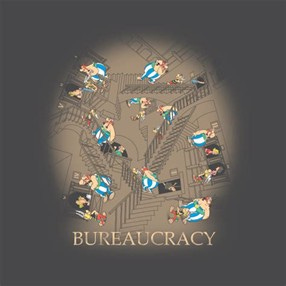
A bureaucracy is an even better tool for politicians. It is a way to endlessly pour money into solving a problem. You can prove you care about a problem by showing that you are willing to spend money to solve it. You also make your opponent seem heartless if they want to do anything sensible, like stop spending money we don’t have.
Jerry Pournelle had a background in operations research and space policy and became a very popular Science Fiction writer. He co-authored several outstanding books with Larry Niven. One was a modern take on Dante’s Inferno. Pournelle obviously disliked bureaucracies. One level of Hell in their novel was to spend eternity trying to get a form filled out correctly to satisfy a clerk.
He also had what he called his “Iron Law of Bureaucracy.”
In any bureaucratic organization there will be two kinds of people: those who work to further the actual goals of the organization, and those who work for the organization itself. … The Iron Law states that in all cases, the second type of person will always gain control of the organization, and will always write the rules under which the organization functions.
Thomas Sowell did a summer internship at the Department of Labor in Washington near the end of his doctoral studies at the University of Chicago. His experience is a case study of whether politicians or agency leaders worry about whether their agencies help the people they were set up to help.
Sowell had gained employment as an unskilled young black man at a time when the minimum wage hadn’t caught up with inflation. He studied minimum wages in Puerto Rico and decided they didn’t help. It was something the people he worked with didn’t want to hear.
It forced me to realize that government agencies have their own self-interest to look after, regardless of the interests of those for whom a program has been set up.
Administration of the minimum wage law was a major part of the Labor Department’s budget and employed a significant fraction of all the people who worked there. Whether or not minimum wages benefited workers may have been my overriding question, but it was clearly not theirs. They had reasons to want to believe that it did, but no real incentive to probe too deeply to find out.
Which leads to another, even more poisonous, way to “help.” Over-regulation and price-setting smother an economy. I don’t have the space here to describe all the possibilities. Rent control prevents people from buying or building properties to rent.
There is currently a significant push to raise the minimum wage nationwide. Sowell has noted that the actual minimum wage is zero. Investors have no reason to open a business if they won’t make money. Labor costs are a factor in that analysis. Stores and restaurants may also be closed if labor costs exceed returns.
Just because money is being spent to “solve a problem” doesn’t mean that anyone wants the problem solved. In fact, by constantly redefining the problem, an agency can go on forever. Politicians have a cause. Agencies are filled with people who vote for them. Recipients and suppliers form a voting bloc committed to maintaining the flow of funds.