
Three Presidents pursued important goals even though they understood it could have serious political costs. They risked those consequences because they believed their actions were more important.
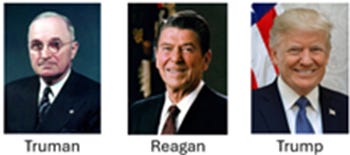
Harry Truman
Harry Truman is one of my favorite presidents. He never sought the office or expected it. He was on the ballot to replace Henry A. Wallace, who was too liberal for many of the party leaders. Roosevelt told him nothing, and FDR’s people treated him as a usurper. Yet he made decisions that shaped the next fifty or more years. Overall, he did an excellent job.
Of those decisions, I will cover his actions in Israel’s first days. I had a good sense of it, but an excellent YouTube video on the subject was very helpful in reminding me of the details.
In May 1948, Truman was running for a full term as President. Many people saw him as a small man who was not big enough to fill the shoes of the giant he replaced. All the polls indicated he would lose.
Israel looked to be another losing proposition. They planned to declare independence on May 14th. Because it was surrounded by enemies who had oil and friends, nobody expected the fledgling state to survive for a month. Britain made its lack of support for Israel obvious.
The most respected man in America, George C Marshall, was Secretary of State. His department was completely opposed to recognizing Israel. They correctly foresaw problems that persist today. The Arab world hated the idea of a Jewish presence in the area, let alone a state. Israel could not match the oil reserves or the sheer numbers of the Arabs. The “logical” thing to do was to simply not recognize the declaration of the new state, not support it militarily, and let the Arab world destroy it and end the problem.
Marshall strongly presented his department’s position in a White House meeting on May 12th, two days before Israel’s declaration. Although Marshall never voted, he told Truman that if he recognized Israel and Marshall were a voter, he would not vote for Truman.
I will refer you to the YouTube piece for more details. Truman not only recognized Israel within minutes of their declaration, but he also supported them unofficially, both diplomatically and by not enforcing policies that would have prevented them from receiving military equipment.
His actions made an essential difference. Without them, Israel would not have survived.
Ronald Reagan
When Ronald Reagan took office, the nation was suffering through what Keynesian economists had thought impossible. “Stagflation” was a combination of a stagnant economy and inflation. Washington Post columnist Robert Samuelson wrote about Reagan’s role in this and listed some of the numbers. “Inflation was 13.3 percent in 1979.” “From the late 1960s to the early 1980s, there were four recessions.”
Samuelson’s column was a response to a column by Paul Krugman, which gave Reagan no credit for the actions in the early 1980’s that helped end the inflation cycle.
Samuelson’s column was titled “Volcker, Reagan and History.” The column explained that Reagan had the understanding and political courage his predecessors lacked. That changed everything and enabled Federal Reserve Chairman Paul Volcker to implement the policy tightening needed to end inflation.
Even now, President Trump is complaining that Jerome Powell is keeping interest rates too high. Most Presidents want rates lower because it is easier for people to borrow and spend. Throughout the chaos of the seventies, every attempt to raise rates to fight inflation caused pain; people complained, and presidents and other politicians yelled at the Fed to back off and lower rates. The standard political view was “fix the problem after the next election.”
Reagan majored in economics and sociology in college. He studied economics before Keynesian theory reigned. He believed in hard money. The pain of ending inflation was real. Samuelson wrote that Reagan had the courage to provide protection.
It’s doubtful that any other … candidate … would have been so forbearing …
What Volcker and Reagan accomplished was an economic and political triumph. Economically, ending double-digit inflation set the stage for a quarter-century of near-automatic expansion (indeed, so automatic that it bred the complacency that led to the 2008-2009 financial crisis — but that’s another story). Politically, Reagan and Volcker showed that leaders can take actions that, though initially painful and unpopular, served the country’s long-term interests
…
Volcker later said of Reagan: “Unlike some of his predecessors, he had a strong visceral aversion to inflation.”
But that move cost Reagan deeply in the 1982 midterm elections. The nature of the Congress changed, making his life more difficult.
Donald Trump
Donald Trump left the worlds of entertainment and business because he believed certain things needed to change. One of those was the threat to world safety caused by the existence of the regime in Iran. In 1980, he had an interview with Rona Barrett. He spoke about the hostages then being held in Iran and was obviously frustrated by the Carter administration’s timid response. He spoke about the way nations could and did disrespect the United States. He and Barrett also discussed why many capable people don’t enter politics.
Trump’s highest priority today is avoiding nuclear war and World War III. That may sound overly dramatic, but I am not kidding.
Trump takes the Iranian mullahs seriously. They have said they want to be able to destroy the “little Satan” – Israel, and the “Big Satan” – the United States. They have missiles with a 2,500-mile range and nuclear material.
The hostages were released the day Reagan was inaugurated. Reagan dealt with the economy and ended the Cold War with the Soviet Union. Since then, Presidents have wavered and waffled on the Iranian issue and, at most, dealt with terrorism and other problems the Mullahs created instead of dealing with the primary issue. Even though this is a midterm year, Trump decided he had to make sure Iran’s government had neither the capacity to make nuclear weapons nor the desire to do so.
On another front. Trump recognizes the risks in pushing Russia too far in Ukraine. This deserves more room than I have here. Put simply, Russia has not ruled out nuclear weapons, and European rulers seem trigger-happy. Even at the risk of being called “Putin’s Puppet,” he is determined to make sure Russia does not feel even close to being desperate enough to “go nuclear.”
There are risks to both issues regarding the 2026 midterms. European leaders are using Russia as an external “bad guy” to move the discussion away from their bad policies. Trump is taking a major risk to make the world safer, even at political risk.