
Thomas Sowell is the author I both respect and enjoy as much or more than any other. His life is described in his autobiography, A Personal Odyssey. He is a black man born in poverty in Gastonia, North Carolina, in 1930. In 1939, he moved to Harlem in New York City. After time in the Marine Corps, he started his college work in Economics. He earned his baccalaureate at Harvard, his master’s at Columbia, and his doctorate at the University of Chicago. In 1980, He became a Senior Fellow at Stanford’s Hoover Institution.
He has extensively studied the culture of various groups that influences their economic performance. In 2005, he published Black Rednecks & White Liberals, a study of various groups. He analyzed economic behavior within and between groups. Many of us recall with delight the many years when C-Span’s Brian Lamb would conduct the best book discussions anywhere. A YouTube producer called Bloodlines and Borders built an excellent video about Sowell’s ideas on groups, which begins with Lamb talking with Sowell about his book Black Rednecks & White Liberals.
.Lamb> You have a chapter that’s the first chapter is Black Rednecks and White Liberals. The second chapter is “Are Jews Generic?” Why the jump
Sowell> Well, this book is really about ethnic and cultural issues in general…. They’re lumped together because they’re all cultural ethnic issues. [It’s a] fascinating story because among the middleman minorities of which the Jews are the most prominent, the hostility of these people in countries around the world is out of all proportion to that to any other kind of group I can think of.
I will cover various aspects of this chapter in future articles. For now, I’d like to explain the concept and the emotions involved. Middlemen provide a necessary service that involves financial risk and involves delayed gratification. They are often accused of greed when their costs rise, even though they haven’t raised their margins. If the task is performed by a minority ethnic group, this is Sowell’s “Minority Middleman.”
The hostility to Jews found in black ghettos, before Jews began pulling out in the wake of the ghetto riots of the 1960s, has been directed in later years at Korean and Vietnamese middleman minorities who succeeded the Jews in those roles. In even earlier times, before World War II, blacks in Harlem were resentful of fellow blacks from the Caribbean, who often played the role of middleman.
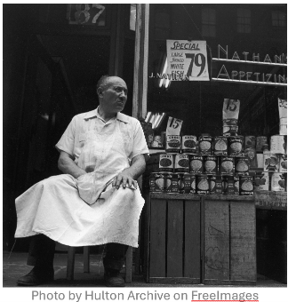
Grocery stores, especially small ones, are easy targets. Costs include taxes, rent, supplies, and the cost for every item of food they stock. They pay the truck driver more if gas or tolls go up. Crime is a cost. Any heavy bars to protect the store cost money. Every mandate the politicians pass to make the world wonderful costs money. The customers see the cost at the grocery store, and the grocer is not “one of us.”
Sowell describes similar groups:
Jews have historically been the classic middleman minority, to whom others have often been analogized—the overseas Chinese as “the Jews of Southeast Asia,” the Lebanese as “the Jews of West Africa,” the Parsees as “the Jews of India,” and the Ibos as “the Jews of Nigeria,” for example. Shakespeare’s merchant of Venice was a Jew and the story revolved around his money-lending. Numerically, however, the 36 million overseas Chinese are more than twice as numerous as all the Jews in the world.
Among other prominent middleman minorities have been the Gujaratis from India, who have played the middleman role in countries ranging from the South Pacific islands of Fiji to the United States and South Africa. Armenians have been another prominent middleman minority in countries around the world, and the Chettiars from India have specialized in the middleman occupation of money-lending in many times and places. In addition to these international middleman minorities, there have been ethnic groups who played this role in particular countries or regions, such as the Marwaris in India’s state of Assam or Koreans in America’s black ghettos.
The YouTube video quotes Sowell, noting that in 1972, Idi Amin expelled the entire South Asian population of Uganda. He called them the brown Jews because of their dominance in commerce and their perceived economic control.
These groups all have similar characteristics as they build their places in society. There are times when they are useful to the leaders for assorted reasons and are protected. At other times, society’s leaders need a scapegoat for public anger, and these minorities serve as better targets than government or church leaders. Sometimes they have been expelled, and the cost has been severe for the society that expelled them.
I posted an article last fall about the return of antisemitism. The increasing prominence of open antisemites among Democratic primary winners makes the subject more important. I will be discussing Professor Sowell’s analysis in future articles.