
From its founding, those who knew how currency worked knew the Euro wouldn’t. It was the currency of some ideal future entity that might eventually come into existence, but does not yet exist. The gap between the two could not be ignored forever.
Money, in all its forms, represents some kind of value and worth. It replaces goods or effort. Before there was money, barter was the only form of exchange. Everything had a value. Land, buildings, animals, crops, slaves, and even women as wives. What was the cost of a certain amount of food for my family for a specific mix of items I had?
With coins, exchange was simpler. A person didn’t need specific items that the other person wanted. Money could be exchanged for the desired item. Money was the stand-in for worth, worth of any kind.
Governments produced money in various formats to represent the wealth in their domains. In the beginning, it was in the form of coins of assorted sizes and weights made of precious metals. The value of the coins was guaranteed by their content.
Paper money eventually became the standard. In theory, anyone could print it. In fact, governments usually retained the exclusive right. The value of a government’s money and the trust in it were signs of trust in that government. In 1865, Confederate money was not very trustworthy, and people were less willing to accept it as payment.
When a country has its own currency, it has some control over its economy. It may do a bad job, but it is impacting its own economy. Some countries have decided to use the U.S. dollar as their currency. They are small countries that never had their own currency.
Most, if not all, of the countries in the Eurozone gave up their own currencies to adopt the Euro. Many of them had gone through dramatic reevaluations or hyperinflations.
Perhaps the most dramatic was the hyperinflation of the German Mark under the Weimar Republic in the 1920’s. Facing huge reparations debts after World War I, the government just printed massive amounts of money.
Before World War I, one US dollar could buy about four Reichsmarks, but by late 1923, the exchange rate had skyrocketed to four trillion Reichsmarks.
Paper Marks were so worthless that children played with them as stacking toys.
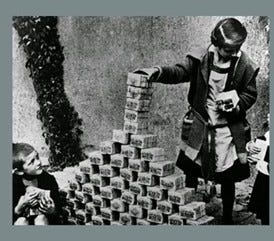
Because the Germans were certain that the Weimar chaos played a role in Hitler’s rise, they were determined to avoid a repeat of that kind of inflation after World War II. With an industrious workforce, excellent industrial capacity, and inexpensive energy, Germany could produce high-quality products for export and compete on price.
Southern European nations, such as Spain, Italy, and Greece, routinely inflated their currencies. They have massive government overheads before anything could happen. The workforce of these countries was not competitive. The delays involved before anything could be done meant investors went elsewhere. Pensions and government wages were denominated in the local currencies. Reducing the amounts would be difficult. It was politically easier to devalue the currency than to reduce pension payments.
Before joining the Euro, each country controlled its own currency. Their decisions did not directly impact the others. It is true that one country could devalue its currency to gain a competitive trade advantage, and others would respond. But if a country had inflationary issues, it didn’t harm other currencies.
Lenders evaluated each nation’s currency separately. The German Mark was stable and trustworthy. The same could not be said about the Greek Drachma or the Italian Lira. If loans to a nation were denominated in that country’s currency, it could determine the value of the loan by devaluing its currency. Lenders knew that and set interest rates accordingly.
After the Euro, loans to countries were made in Euros. A crisis occurred when Greece couldn’t pay its Euro-denominated loans. The lenders had counted on other Euro countries bailing out Greece. They did. But their voters realized the trap the Euro was.
It was possible because Greece is small. The next crisis will be in a bigger country. Also, the Greek problem happened while the Eurozone had some viable economic powers. It doesn’t anymore. That sounds harsh, but it’s true.
YouTube producer The Wealth Records does an excellent job creating short videos (about 20 minutes) on economic and international subjects. They have a “Table of Contents” page showing their videos.
They have a great video on why the Euro was built to fail. There are also shows that will surprise people who aren’t following the news about Europe closely. They describe the disastrous situations in various European countries. This information explains why the Euro will come under pressure and why there is no strength left to hold it up.
France is locked into promises it can’t afford and has a dysfunctional political system. It is far bigger than Greece. There is no way its financial collapse can happen without severely impacting the Euro.
Germany was the tent-pole holding up the Euro for decades. It had everything investors wanted when they sought a safe place to put their money. As the center of the Euro, Germany’s rating reflected well on the other Euro countries. That is no longer true. Germany is in economic and political crisis.
Chancellor Friedrich Merz leads a marginal coalition government and has managed to push through a change allowing the government to spend more than it takes in. Regardless of the reason, Germany’s deficit spending means no Euro country even pretends to want a balanced budget.
All the nations in the Euro are facing financial and political chaos. Why would anyone put any faith in a currency when every part of it could pull it apart in a different direction?