
My little sister would sink her teeth into a question and not let go. As she began Catholic Sunday school to prepare for her first communion, she encountered a straightforward yet highly sophisticated concept: “God always was and always will be.” Infinity is tough for anyone, let alone a seven-year-old.
My sister wouldn’t give up. My father was patiently trying to satisfy her, but it wasn’t working. Finally, she said, “Daddy, I know God always was. What I want to know is – when did he start always Wasing?”
There is a concept akin to infinity that people struggle to grasp, and many famous people have resisted an answer because they don’t want it to be true. To copy my sister’s question: How did the universe start Wasing? Before the galaxies were, what was? Or, to put it the other way, what was there before there was anything?
Stephen Meyer has a Ph.D. in History and Philosophy of Science from Cambridge. He has a YouTube video covering the history of resistance and acceptance of the “big-bang” theory” of the origin of the universe.
He starts by covering how Darwinism gave rise to:
what is sometimes called scientific materialism or atheism. And with the idea that there’s no need, there’s no guiding hand behind evolution. It’s not theistic evolution. It’s not teleological that there’s no purpose behind it. It’s a completely undirected, unguided process, and that, as Richard Dawkins would later say, made it possible to be an intellectually fulfilled atheist.
The prevailing view of the universe was that it had a fixed size. Einstein was concerned that his theory of gravity would cause all objects to collapse into a massive black hole. To counter this, he defined a cosmological constant whose value meant that the universe would neither expand nor contract.
Edwin Hubble, an astronomer, began using the great-dome telescopes at Mount Wilson in Southern California. He saw that what we thought were smudges were galaxies, and they were moving away from us. In every direction, they were moving away. Those further away were moving faster. Meyer describes it as “a kind of spherical expansion like a balloon being blown up. “
Georges Lemaître, a Belgian priest and physicist, was working on Einstein’s field equations and showed serious problems with the mathematics. They were in a taxi together on the way to the conference, and Lemaître confronted Einstein with this. Einstein said:
I don’t like it. Your math is right. This idea of precisely balancing things is unstable. But I just don’t like where this leads as far as a theory. Physics. Theory of the origin of the universe. We’re back to a beginning. And that sounds like a genesis text.
Meyer gives another example:
Sir Arthur Eddington was famously quoted as saying, “Philosophically, the notion of a beginning of the present order is repugnant to me. I should like to find a genuine loophole. I simply do not believe the present order of things started off with a bang. The expanding universe outward from the beginning. The expanding universe is preposterous. It leaves me cold.
Meyer summarizes, “Well, this alternate theory in psychology is known as denial.
In a prior article, I explained how writing computer code inside a mainframe operating system led me to reject random evolution. I am a science fiction fan and willing to accept parallel universes in fiction, but I am still firmly settled in the belief that the creator, or “unsourced source, “ created the universe.
We can’t call it a moment because nothing was there. But at time t-1 nothing existed, then…
In the beginning God created …
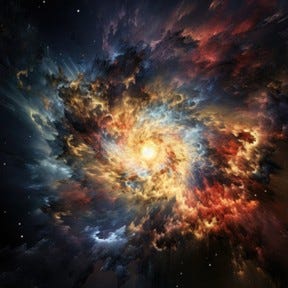
For those of us who accept Genesis 1:1, the idea is fantastic. There is something so incredible: the entire universe exists by choice, and we are allowed to be part of it.
On Christmas Day, the idea moves from fantastic to incredible. For many people, the idea of any connection between a baby in a stable and whatever could produce the Big Bang is, indeed, not credible.
Sometimes, the idea that the creator of the Big Bang came to us as a baby to live a life as one of us, suffer horribly for us, and open a door to everlasting life is a message of love, joy, and hope that we have trouble fully comprehending and living in. We really have trouble remembering that and keeping its depth in front of us when the troubles of the day bother us.
But it is true!