
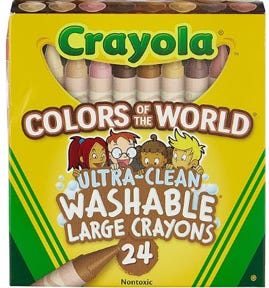
I recently spent time in the hospital in the Research Triangle area of North Carolina. I was struck by the diversity of the people who treated me and provided every service a patient receives in a hospital. They literally come in every color of the human rainbow. I was reminded of an intriguing Crayola offering: a tool that lets children accurately color a picture of anyone.
I received the care I needed because these people, regardless of their color, had the training and skill to perform tasks, up to and including those of surgery and anesthesia.
We live in a strange time where there are people who believe certain skills and habits are “racist” and a sign of “white supremacy” and should not be taught to or required of minority students. This is insane. It not only ruins those students’ lives and futures but also hurts everyone else. A child raised to believe this learns no useful skills or habits. They only learn to blame and hate everyone outside their “tribe” and follow the loudest, angriest, hot-headed demagogue of the week.
Thomas Sowell is a Black man born ninety-six years ago into poverty in Gastonia, North Carolina, near Charlotte. As a child, he moved to Harlem. He learned discipline and was permitted to enter some of New York’s quality schools. His family structure didn’t support his studies, so he needed a few years and the help of the Marine Corps to get back on track, but he did.
He earned degrees in Economics from Harvard (1958), Columbia (1959), and the University of Chicago (1968). He then taught (among other places) at Cornell, Brandeis, and U.C.L.A. He became a Senior Fellow at Stanford University’s Hoover Institution in September 1980 and has been there ever since.
While teaching at Cornell from 1965 to 1969, he witnessed the harm caused by affirmative action. He has been writing about the subject ever since. His major book on the subject is Affirmative Action Around the World. He uses the term “Mismatch” to describe the problem when students are placed in schools where their skill level doesn’t match that of their cohort. Justice Thomas cited his ideas in the Supreme Court opinion for the case involving Harvard and the University of North Carolina.
I’ll limit this discussion to medical programs, but it applies to any technical area and any civil rights issue.
Three groups are involved. The first makes all the noise and all the plans. They want all the credit and avoid all the blame. These are the people who insist on good admissions numbers. They don’t care what happens after that. Agitators, politicians, media, NGOs, and the entire academic bureaucracy live by these numbers.
The next group is the students involved, both the favored minorities and the disfavored. Let’s start with an admittedly arbitrary division. Assume three levels of schools based on the performance percentile of the expected admitted cohort: Good (90%), Very Good (95%), Topflight (98%).
In an ideal world, ability would be the only criterion, and most of the admitted students would understand the material at the rate it is presented, complete the program, and become professionals. If the goal is to produce as many minority professionals as possible, the question isn’t input; it’s output. They must stay in the program.
In his autobiographical A Personal Odyssey, Sowell explained the problem for affirmative action students:
The average black student at Cornell had test scores significantly above the national average for all students — and considerably below the average for Cornell students.
They were not “unqualified” by any means. But they were mismatched with the other students at Cornell. At most other American colleges and universities, they would have been prospects for the dean’s list.
It was not that Cornell necessarily covered so much more difficult material than other institutions … It was the speed with which we covered whatever we did cover that played a large role in leaving these students falling behind.
As a result, minority students dropped out of STEM programs and moved into racial studies or other “anger” studies. They would eventually become social agitators rather than technical professionals.
If the goal is to have as many minority doctors and other medical professionals as possible, we can’t mismatch them. There certainly are top-flight minority students. Every student needs to be stretched to the maximum of their ability. But we also need to match good and very good minority students with the appropriate training.
Affirmative action wastes spots by filling them with mismatched students. Those places never produced doctors. Qualified disfavored students never get a chance to receive the training.
The entire community suffers when there are fewer medical professionals. We need to focus on graduation, not admission.