
I have an interesting relationship with Minnesota. Hubert Humphrey was a Senator from Minnesota and Vice President when he ran against Richard Nixon in the 1968 Presidential election. That was the first time I could vote, and I voted for Humphrey.
I worked with Univac computers, and they have development centers in the Twin Cities. From 1980 to 1982, I lived and worked in the St. Paul area. The people were nice. Frankly, I found the cold and snow overwhelming. We moved to Huntsville, Alabama.
I have been concerned and saddened by what I’ve seen and heard about the changes in that area in the last few years. They have found a way to focus on the negative. When you do that, you produce more negativity.
It is fair to say there is a significant drop in quality from Hubert Humphrey and Walter Mondale to Tim Walz. The current governor’s Memorial Day actions reveal the benchmarks he uses to set his own standards. Those who set low standards usually live down to that level.
Memorial Day is a day when law-abiding and law-enforcing people pay tribute to those who gave all to protect the nation and its freedoms.
Minnesota Democrats tried to change the day into something related to the death of George Floyd. This was a man with a long criminal record who was violating a restraining order to stay away from a woman who had reason to fear him. Townhall cartoonists Margolis and Cox have an excellent cartoon showing a generic Democrat ferociously destroying a memorial headstone.
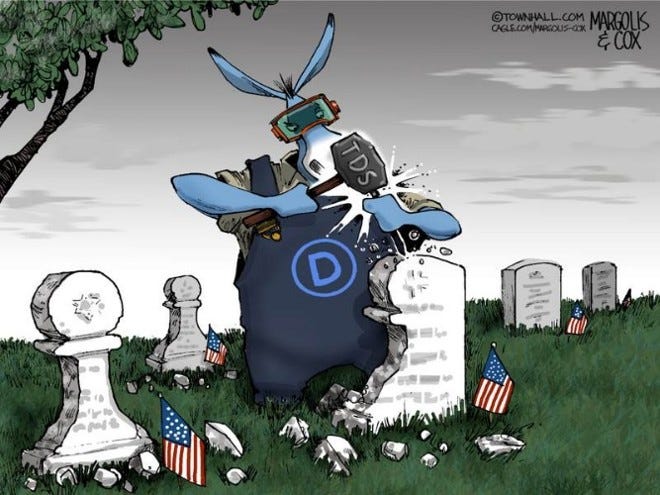
The tragedy of today’s progressives is the idea that no one, past or present, is as concerned about the world’s real problems as they are. The people of the past may have solved one problem or another, but those problems aren’t as important as their issues.
They grant that ending slavery, widening suffrage, improving working conditions, health, and living standards were all right. But that’s what previous generations were supposed to do. If they truly were good, they would have solved the real problems we’re dealing with: microaggressions, overpopulation, xenophobia, climate change, and all the other evils of human nature.
They admit that Hitler had to be stopped but say that we don’t give Soviet Russia enough credit. They know communist governments in Russia and China each killed more of their own people than Hitler, but their goals were more noble. Also, they are certain that when they become the leaders of a communist society, they won’t be harsh. Human nature will change. Everyone will see their wisdom and no harsh methods will be needed.
They take a different lesson from Aldous Huxley’s Brave New World and George Orwell’s 1984. They see that whoever controls the present controls the story of the past. Winston Smith in 1984 constantly rewrites the past. Both Orwell and Huxley describe societies that prevent forbidden thought by removing any triggers for those thoughts.
It may seem silly or pointless when progressives destroy monuments, paintings, or other tributes. It’s not. When the accounts of founders or leaders like Washington, Lincoln, or Churchill are erased, their histories, ideals, and victories no longer need to be explained away or countered.
Memorial Day is a tribute to those who agreed to fight for a specific purpose. A discussion of those purposes raises issues and ideas that are best ignored and buried in the trash bin of history. So, they refuse to take the standard lessons from history. They see them as folk tales and propaganda to keep the masses in line. They don’t want the public to honor anything which differs in any way from the soon-to-be party line.
Put simply, those who think they have big enough hearts to understand what creates anti-social people tried to take a day meant for those who gave their lives for others and turn it into a day to celebrate their caring and a thug and a taker.
There is another part of this refusal to look up to the heroes of the past. When we focus on helping others, it is easy to consider ourselves virtuous. We have our lives together. Those we help have problems. The helpers give from a position of social superiority. They don’t have to improve to match their standards. Helping others is necessary and wonderful, and those who do it are heroic, but making them role models is not appropriate.
When we extend honor to a person or group, past or present. We are acknowledging a trait or act that benefits society in some way. We are called to look at that beneficial behavior and try to benefit those around us in some way. We won’t do the same thing, but we can look at their behavior and attitudes and use that to do better than we did yesterday.