
When politicians of both parties are willing to push congressional districting to the limits, they will play every game they can. That eventually includes lawsuits and court cases. This month has been active and momentous on that front. Recently, both the Supreme Court of the United States (SCOTUS) and the Supreme Court of Virginia (SCOVA) handed down major decisions.
United States – SCOTUS
The federal courts began a journey years ago that troubled many, both lawyers and laypeople. Recognizing that Blacks had been mistreated for years, they thought it would be inadequate to simply make things equal and fire a new starting gun. They permitted various forms of racial favoritism to allow a period of catching up. Sandra Day O’Connor wrote that this would not be permanent but was needed temporarily. Some of these “temporary” measures have been in place for more than fifty years.
Justices Thomas and Alito have been leaders in calling for an end to this. 2026 is the year SCOTUS is making the change. One measure was affirmative action in college admissions. The court ruled in favor of students who sued Harvard to stop this.
Another area was an interpretation of the Voting Rights Act requiring the creation of “majority minority” districts to ensure that minorities are elected. Democrats and the NAACP brought suits to force states to add more of this type of Congressional district. U.S. District Court orders did that in Louisiana and Alabama. Another suit was pending from North Carolina. Both legislatures took the issue to the Supreme Court. In Louisiana v. Callais, SCOTUS struck down a plan to create a district specifically shaped to ensure the election of a second Black representative.
District six was majority Black. District two was redrawn as a second majority-Black district following a lower-court order. That was the subject of this lawsuit.
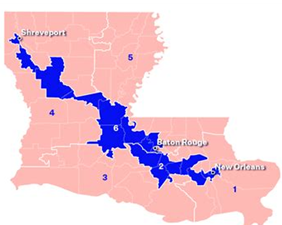
After that ruling, SCOTUS vacated a lower court ruling ordering Alabama to add that kind of district. A similar suit seeking a court order to redraw lines in North Carolina was withdrawn.
This will not necessarily be an overwhelming loss for the Democrats. If you take a district that is overwhelmingly Black and Democratic and move some of its voters, you are adding Democratic voters to other districts. The Republicans must be careful how they do it.
Virginia – SCOVA
Virginia had a constitutional amendment controlling its redistricting. A bipartisan commission drew the lines with fairness in mind. It worked. The eleven-seat Virginia delegation had six Democrats and five Republicans. That split matched the 2024 Presidential and U. S. Senate vote percentages.
In 2025, the Democrats made the state elections about Donald Trump. Don’t ask what we’ll do, just talk about him. When they got in, they weren’t the typical blue to purple Virginia party people expected. They went all-out woke, including genetic males in women’s locker rooms and sports, and an anti-ICE, anti-law enforcement attitude.
They argued that the need to stop Donald Trump meant they had to help the national party get control of the House of Representatives by any means necessary. They scheduled a referendum to allow a new redistricting to replace the balanced one the people had just voted for.
There was some doubt about the legality of the timing on this. The state constitution requires an election between the proposal of an amendment and its vote. The legality turned on the definition of an election. Those who wanted to have the referendum argued that “election” meant just election day. The opponents noted that more than a million votes had been cast by early voters in the 2025 elections when the amendment was proposed. That meant an election was happening, and no amendment could be put before the voters until 2027.
Plaintiffs sought to block the referendum, but the Virginia Supreme Court wouldn’t hear the case before the vote occurred. I have seen courts refuse to hear cases and permit unfair and questionable voting changes. In a previous article, I didn’t understand why the court allowed the referendum to proceed.
During oral arguments, a question was raised about whether the court would consider the voters’ approval of the referendum in its deliberations. They said that did not matter. That is true in one sense, but not another.
In a YouTube video, former Virginia Attorney General Ken Cuccinelli explained that the court does not rule on legislation until the governor acts. They don’t waste their time on a bill that might be vetoed. They viewed the referendum the same way. The voters could have “vetoed” the legislature’s action by voting down the amendment. The 51.5 to 48.5 was close, but it did pass. That meant there was a law to consider, and the court did so.
Various ideas are being considered now. Most of them are poisonous. The current 5-6 districting plan could be replaced by a new amendment. One proposal would fire all the justices and replace them with people more accommodating to the legislature.
The courts will always be seen to be involved in redistricting. Even if a court refuses to hear a case, the would-be plaintiffs will think that the court has taken the other side.