
There is, indeed, a role for community in individual behavior. That role can support good behavior or allow immoral behavior. But we have had it backwards for the last sixty years or so. We have blamed the community for individual misconduct and viewed society’s attempts to limit immoral behavior as attacks on freedom. We naturally observe more misconduct as a result.
In a recent City Journal article, Charles Fain Lehman described the most prominent sociologist of the last 100 years as follows:
in the 1970s and 1980s, James Q. Wilson waged a one-man battle against a thousand sociologists, criminologists, and other academics. The punchline: “A thousand to one against Wilson—that’s almost a fair fight.”
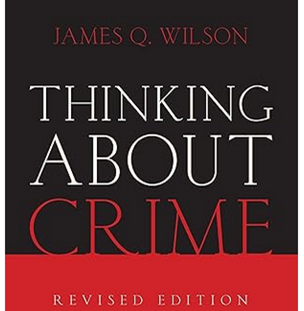
Lehman discusses Wilson’s 1975 book Thinking About Crime, but the ideas apply to all forms of behavior. The prevailing theories of crime, then and now, sought reasons or excuses to place responsibility on society rather than on the individual who committed the act.
“Strain” theory, for example, held that deviance arose when people acted out in response to their inability—imposed by social circumstances—to achieve socially desirable goals through legitimate means. “Labeling” theory, meanwhile, argued that criminals offend because society “labels” them as such, turning temporary malfeasance into a lifelong condition.
Note that this makes the community responsible yet unable to act. Criticizing offenders or imposing harsh punishment is seen as insensitive. It isn’t their fault. These problems have “root causes” that cannot be solved.
An opposing view is that of the “social control” theorists, who saw crime not as something caused but as something to be prevented. Our social bonds, or systems of “social control,” constrain us.
Here is the key definition of community and social organization as Lehmen describes it:
What is community? For Wilson, it was not the warm fuzzy sentiment that the word sometimes evokes. Rather, community meant a shared set of norms of “right and seemly conduct” and the ongoing process by which those norms are reinforced. Disorderly behavior—rowdy teenagers, lurid advertisements—undermined those shared norms and disrupted that process. The breakdown of this process, more than any strain or label, was, Wilson believed, a major driver of rising crime.
This explains two significant issues. Heather MacDonald, in her book The War on Cops, talks about how the Black people in poor neighborhoods want more police so they can have a peaceful, even dull, lifestyle. Additionally, one of the major disruptions caused by massive immigration is the change in the community’s character within a neighborhood.
In 1982, Wilson and George Kelling published a seminal article in The Atlantic Magazine proposing the “Broken Windows” theory.
Kelling had shadowed a foot patrol officer and sought to understand the officer’s perspective on his job.
[He] was practicing what they called “order-maintenance” policing: not solving crimes but keeping the peace. This, they suggested, was what made residents of foot-patrolled neighborhoods feel safer and believe that crime was falling. The police weren’t lowering the murder rate simply by walking the beat; they were addressing the “forms of impropriety” that, in Wilson’s framework, erode community.
Crucially, it is the community, not the police, that does the most to control crime. “The essence of the police role in maintaining order is to reinforce the informal control mechanisms of the community itself,” Kelling and Wilson wrote. “The police cannot, without committing extraordinary resources, provide a substitute for that informal control.” From this insight came Broken Windows theory. “ ‘Untended’ behavior,” they observe, “leads to the breakdown of community controls,” setting off a downward spiral in which eroding norms give rise to more serious crime.
Here is the problem with American law and society in the last sixty years. John Adams said, “Our Constitution was made only for a moral and religious people. It is inadequate to the government of any other.” This assumes a group in which the vast majority is law-abiding and exercises self-control. They are also expected to and allowed to exert social pressure on those who are not.
Once politicians and lawyers began catering to offenders and explaining away their transgressions, healthy social constraints were not expected; they became taboo. Suddenly, transgressors and those who “cared for” them were more important than the healthy contributors to society.
Lehmen deals with another of Wilson’s concepts – “civil peace.” He notes that this dates to Roman times and is reflected in Western Law. There are terms such as “Disturbing the Peace” and “Disorderly Conduct.” Various governments, or “The People” are often the plaintiffs in criminal cases: The United States vs., The State of ... vs.”
Crimes are not victimless. Homeless people make cities unlivable. When business property values collapse, real people lose real money. When subways aren’t safe, many city entities are affected. Judges and politicians who think they are showing concern are destroying the kind of community needed to hold a society together.
Much of this article is drawn from Charles Fain Lehman’s excellent article; I would be guilty of plagiarism if I didn’t acknowledge that this is an “article review.” His article is about twice as long, and I urge you to take the time to review it.
https://www.city-journal.org/article/james-q-wilson-thinking-about-crime-50
He concludes with this important idea from Wilson. This point demonstrates the harm the courts have inflicted not only in criminal law but across the entire spectrum of morality and law.
Taking Wilson seriously means recognizing that such sobriety rests on his broader vision of crime and its causes. Crime occurs not from deprivation but from the absence of forces that restrain it—forces subtle and easily disrupted, as they have been by the legal and cultural war that the nation has waged against them for decades. We need to end that war and restore order to its rightful place in law and culture, or we will pay a steep price.