
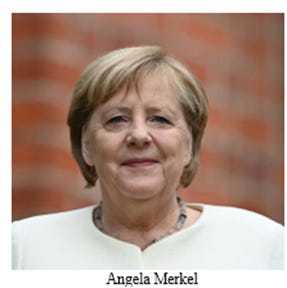
When Angela Merkel became Chancellor of Germany on November 22, 2005, she led a country much stronger than Germany is today. Her decisions and actions damaged that nation and its people.
After World War II and its experiences with Weimar and Hitler, Germany was determined to be fiscally conservative and politically moderate. The Germans were noted for diligence and their mechanical skills. The positive aspect of having their country destroyed was that they had to rebuild from scratch. They knew how to do things. The replacement factories were clean, fresh, and efficient.
Immigration
Germans shared a worldview and a way of being. They agreed on how to take care of their homes and yards. The homogeneity of society and its shared experiences let people get along naturally.
For fifteen years, from 1991 to 2005, Germany’s foreign-born population stayed in the 6.5 to 7.5 million range. During Merkel’s sixteen years in office, the foreign-born population increased to 11.82 million. In 2015 alone, more than one million migrants entered Germany.
Worse than the sheer numbers were the way the newcomers were treated. They were not held to the same behavioral standards as the German citizens. This was especially true when it came to the way immigrant men were treated. New Year’s Eve 2015 in Cologne was the night that made it impossible to ignore the problem.
Deutsche Welle is a major news organization in Germany. They explained:
Nearly 1,000 men of North African and Arab origin are reported to have divided themselves into smaller groups and robbed and sexually harassed women at Cologne’s central station on New Year’s Eve. Similar incidents occurred on a far smaller scale in Hamburg and Stuttgart.
Five years after the event, Ralf Bosen wrote a long piece in that paper describing the event and the consequences.
Because what happened in Cologne brought fundamental sociopolitical issues to the fore, it triggered a worldwide media response.
During his US presidential election campaign, Donald Trump portrayed the attacks as a cautionary tale from a misguided refugee policy.
In Germany itself, the long-running debate about migration policy and how to live together in a pluralistic society flared up.
He also noted that the media and the police “were accused of being too hesitant to report on the foreign citizenship of the suspects.”
Energy
Her energy policies were even more disastrous. There are many YouTube videos on the subject, but I’ll recommend this one. The video starts by showing how Germany was a leading industrial power at the start of the century. It had skilled, industrious people. But it also had cheap, plentiful energy. Vast amounts of energy are required to produce steel, chemicals, automobiles, and other products. Energy moves people to and from work, powers farm equipment, and keeps hospitals running. When Germany was strong, it had ample, comparatively inexpensive energy from multiple sources, including nuclear.
In 2011, Germany adopted a plan called the Energiewende or Energy transition. They were going to spend five hundred billion Euros to move to completely clean, renewable power. Solar and wind would replace nuclear and petrochemical energy. The video explained:
Solar panels produce no electricity at night and very little on cloudy days. Wind turbines produce no electricity when the wind is not blowing. Germany has a word for periods of low wind and low sunlight. Dunkelflaute, dark doldrums.
When the country is in the “dark doldrums,” other energy sources are needed. That means wind and solar can’t replace anything. The traditional sources must be maintained and ready to operate when the renewable sources can’t do the job. But Merkel and Germany failed to do that. The Energiewende called for the elimination of all nuclear power. To make things worse, Merkel rushed the closing for political reasons.
When the Fukushima nuclear disaster happened in Japan in March 2011, German Chancellor Angela Merkel made a decision that will be studied in economics and policy schools for generations. Within 4 days of Fukushima, she announced that Germany would shut down all of its nuclear power plants. Not gradually, not carefully, not after building replacement capacity. Shut them all down by 2022.
Without nuclear, coal and natural gas were the backups in the doldrums. Coal is a major pollutant. Russia was their primary source of natural gas. Many people, including American President Donald Trump, warned them that this would make them vulnerable to Vladimir Putin. They scoffed and closed the nuclear plants. They cooperated with Russia to build the Nord Stream pipeline to receive more natural gas from Putin.
Parliamentary government can give a small but significant party a role in successive governments by joining whichever party needs a few more members to form a majority. Germany’s Green Party has used its size to make up part of the majority for years. It has been the driving force behind the major party in the governing coalition in adopting stricter environmental policies. There has also been pressure from the European headquarters in Brussels.
Even so, Merkel’s failure to protect Germany from insane energy policies has been disastrous. Major companies are moving production out of Germany because they can’t compete when their energy inputs are four times more expensive than their competitors’. BASF, the world’s largest chemical company and one of Germany’s most important employers, began shifting investment out of Germany in 2022. Volkswagen had its first plant closure in the company’s 87-year history.
Even worse, the cost of auto fuel and heating a living space in wintry weather has also risen fourfold. The German people are suffering. The most basic thing German Chancellor Friedrich Merz could do would be to work to end the Russia-Ukraine conflict and the related sanctions and get Russian natural gas flowing back into Germany. He is not doing that. He wants to punish Russia at any cost, no matter the harm to his own people.
Time for a change?
Given the dreadful changes in German life in the last twenty years or so, the public is ready to try something different. A political party has risen, calling itself an alternative for Germany. (Alternative für Deutschland - AfD) You would think the leadership would understand the public’s reaction, but they don’t. Instead of reading this as a need for change, they are trying to ban the AfD by labeling it as extremists.